

Pull Up a Chair: The Weird and Wonderful History of Taffy
| BY DANIEL ROTHSTEIN
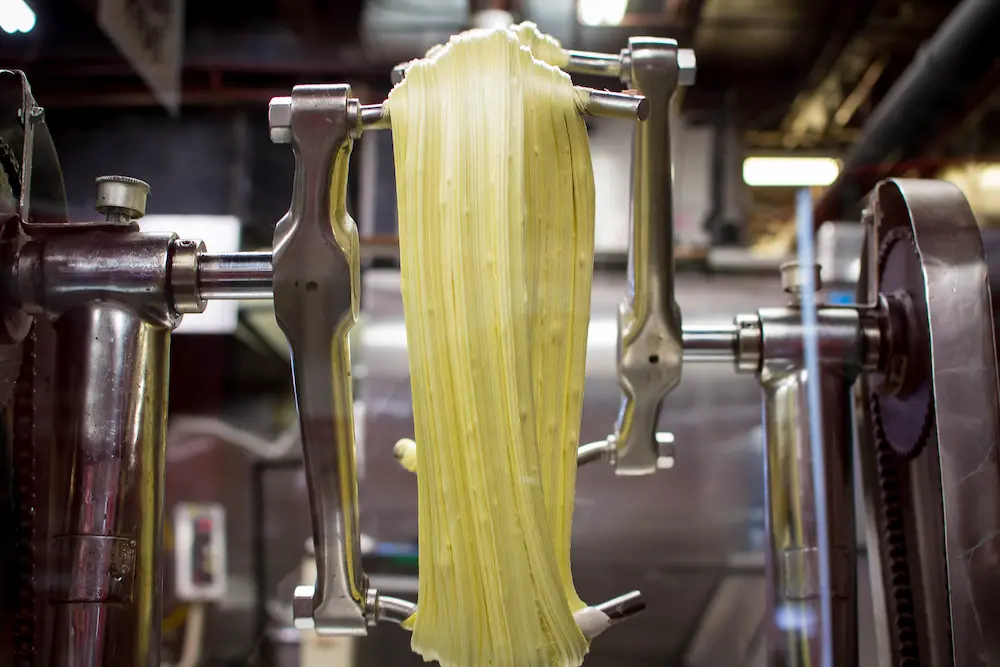
There is a very specific kind of gift shop that exists in every beach town in America. You know the one. It has a screen door, a rotating rack of novelty keychains, approximately fourteen varieties of the same seashell, and a taffy puller in the window. The taffy puller is always running. Nobody stands there and watches it for any practical reason. Everyone stands there and watches it anyway. There is something genuinely hypnotic about that slow, rhythmic stretch and fold, and by the time you stop watching, you have already decided you are buying a bag.
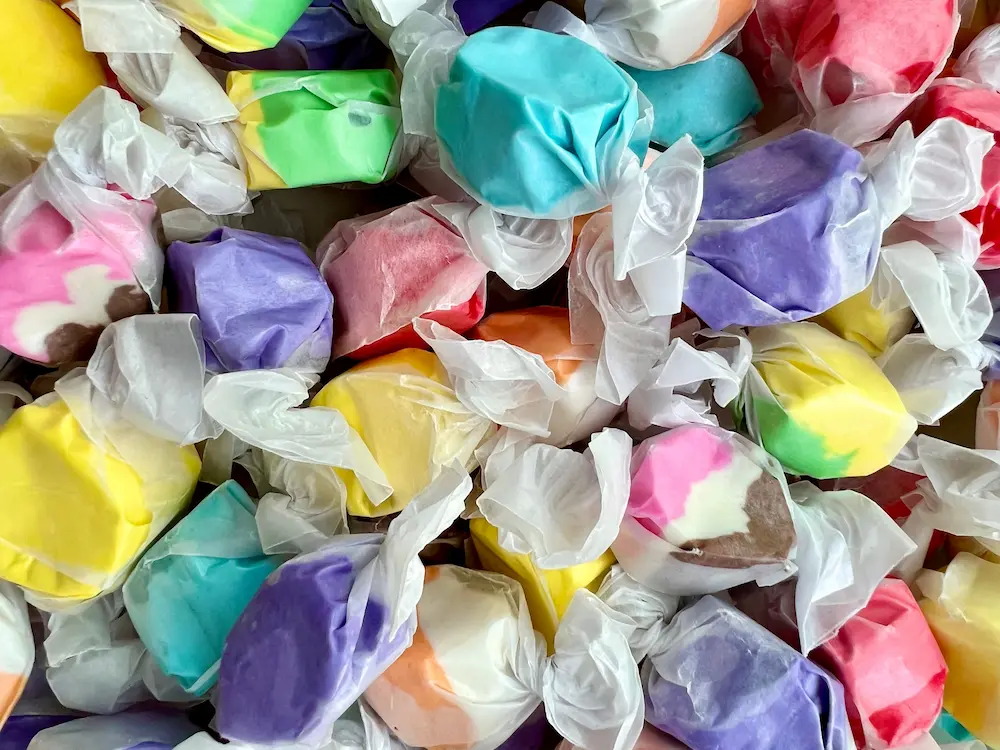
Saltwater taffy is one of those rare candy products that has built an entire cultural identity around itself, one that is so durable it has survived for well over a century without much need for reinvention. But the story behind how it got there involves disputed origins, a possibly fictional founder, a storm that may or may not have actually happened, and a candy format that once served as the centerpiece of Victorian-era social life. It is a weirder history than the chewy little candy deserves. We love it for that.
The Atlantic City Origin Story (Or Stories, Plural)
The most popular version of the saltwater taffy origin story goes like this: sometime in the 1880s, a candy shop owner named David Bradley was operating a stand on the Atlantic City boardwalk. A storm surge rolled in, soaked his entire inventory of taffy with Atlantic Ocean seawater, and rather than throwing it out, he sold it anyway as "saltwater taffy." The name stuck. The candy became a boardwalk institution.
There is one small problem with this story. Historians have not been able to conclusively confirm that David Bradley existed. The tale appears in candy lore with the confidence of established fact, but the paper trail is thin. What is confirmed is that saltwater taffy was being sold on the Atlantic City boardwalk by the 1880s and that the name was trademarked, briefly and unsuccessfully, by a candy maker named Joseph Fralinger in 1923. The trademark was contested and eventually ruled unenforceable because the term had become so generic. Fralinger did not invent the name. He just tried, and failed, to own it.
A competing origin story points to candy maker John Ross Edmiston, who may have used the term earlier than Fralinger. A third version credits a different boardwalk vendor entirely. The honest answer is that saltwater taffy, like most beloved regional foods, probably evolved organically through multiple hands, in multiple shops, over a period of years, until the name was everywhere and the candy was inseparable from the boardwalk experience.
The salt, for the record, is real. So is the water. Both are standard ingredients in the recipe, which is why the name stuck even after the storm surge legend was mostly debunked. The ocean did not invent saltwater taffy. But it did give the candy its identity. If you enjoy this kind of origin deep-dive, our look at the history of the lollipop covers another candy with a surprisingly tangled past.
The Victorian Taffy Pull: When Candy Was a Social Event
Before the Atlantic City boardwalk industrialized taffy production, a different version of taffy culture existed in American homes and community halls. Taffy pulls were a legitimate form of Victorian-era entertainment, particularly for young people. The premise was simple: you made a batch of taffy, and then a group of people pulled it by hand, stretching and folding it repeatedly until the texture became light, aerated, and properly chewy.
This sounds like a chore. It was treated as a party. Taffy pulls appear regularly in 19th century social columns, in novels of the period, and in the kind of earnest domestic advice literature that instructed people on how to run a respectable household. The physical act of pulling taffy required two people working together, which meant it was an acceptable reason for young men and women to be in close proximity and touch each other's hands. Candy historians have noted, with some amusement, that the taffy pull functioned as a socially sanctioned mild flirtation mechanism in an era when those were not always easy to come by.
The home taffy pull declined as commercial taffy production scaled up and the candy became something you bought rather than made. But the image of the taffy puller, that slow machine doing in public what families used to do in their parlors, is a direct visual callback to that earlier social ritual. The boardwalk taffy window is more nostalgic than most people realize. For a deeper look at how nostalgia drives candy sales, our post on why nostalgia candies always sell well is worth reading.
Laffy Taffy and the Modern Market
Somewhere between the Victorian parlor and the Atlantic City boardwalk, taffy evolved from a regional specialty into a mass-market candy format, and the candy that arguably did the most to push taffy into the modern mainstream was Laffy Taffy.
Laffy Taffy launched in the 1970s under the Willy Wonka Candy Company brand, with a softer, stretchier texture than traditional saltwater taffy and the addition of printed jokes on every wrapper. The jokes are famously terrible. This is fully intentional and has been for fifty years. The groaner factor is part of the brand identity, and it has proven to be remarkably durable. Laffy Taffy jokes show up in social media posts, in classroom joke trades, and in the kind of affectionate mockery that signals a candy has genuinely embedded itself in the culture.
The format has also expanded considerably. Laffy Taffy Rope, mini varieties, sour varieties, and limited-edition flavors have kept the brand current while the core product keeps selling on pure nostalgia. It is one of the cleaner examples in the candy industry of a brand that found a personality, committed to it completely, and never needed to dramatically reinvent itself. For more on how nostalgia brands hold their ground across generations, our overview of retro candy treats that still rule covers the broader category.
Why Taffy Belongs in Your Store
For candy store owners, taffy has a few characteristics that make it a consistently smart inventory choice. The price point is accessible, which means it is easy for customers to add to a purchase without hesitation. The variety is wide, from classic saltwater flavors to tropical fruit to sour formats, which gives every customer something familiar and something surprising. And the nostalgia connection is powerful in a way that is hard to manufacture: taffy has genuine cultural memory attached to it across multiple generations of candy buyers.
The boardwalk connection also gives taffy a natural home in tourism-adjacent retail. Any store that serves customers who are in a vacation or outing mindset, whether that is a beach shop, a downtown gift store, an amusement park concession, or a candy destination shop, benefits from having taffy on the shelf. It is one of those products that says "you are somewhere fun right now" in a way that few candy formats can. If you are thinking about building a store experience around that kind of atmosphere, our guide on how to open a profitable brick and mortar candy shop walks through the full setup.
And if you happen to have a window display? A taffy puller is still the most effective candy marketing tool ever invented. People will stop. People will watch. People will buy. It has been working since the 1880s, and there is no reason to think it is stopping anytime soon. For ideas on what to put around it in the display, our roundup on candy display strategies that attract customers has the playbook.
Looking to stock a full range of taffy and classic candy formats for your store? Sign up for a wholesale account with Redstone Foods or give us a call. We have been helping candy retailers find the right product mix for almost 60 years, and we would love to help you pull something great together.
1-800-444-3520